
Category: Tutorials

HEIC to JPG Conversion

The latest Apple iPhone camera format has a more efficient algorithm for storing image information in less space. Unfortunately, unless you work regularly in the Apple environment – MacBook, IPad, IPhone – the format may be unviewable. These are hopefully temporary growing-pain for this new efficient image format as more and more photography programs accept the new format. In the meantime, there are several workarounds to work with or convert HEIC to JPG:

  • HEIC to JPG (for Windows, free)      https://www.copytrans.net/copytransheic/
    I find converting the HEIC to JPG to be one of the easiest solutions and this free utility makes it pretty easy to convert multiple heic to jpg photos.
  • In Windows 10/11, you can convert a HEIC by viewing the photo in Windows Photo, usually accessed by double-clicking the heic file. You may need to install Microsoft Window’s free file extension:

then click the … in the upper right corner and ‘save as’

then select ‘jpg’. This is easy but if you are doing more than one photo, you’ll have to repeat the process for each image.

  • Microsoft Windows Store has a bunch of free and paid apps that will convert HEIC to JPG if you want more features:

Google ‘HEIC to JPG’ and there are plenty of articles that explain many ways to convert HEIC to JPG. I ended up changing my iPhone image format to JPG to eliminate the need to do the conversion since I post many photos online. Once HEIC works with WordPress and browsers, it will become my format of choice. But unitl then, the space savings of the new format are not compelling enough to add the inconvenience of the conversion step.

Googled “HEIC to JPG’ articles: How-To-Geek Article & Tom’s Guide Article
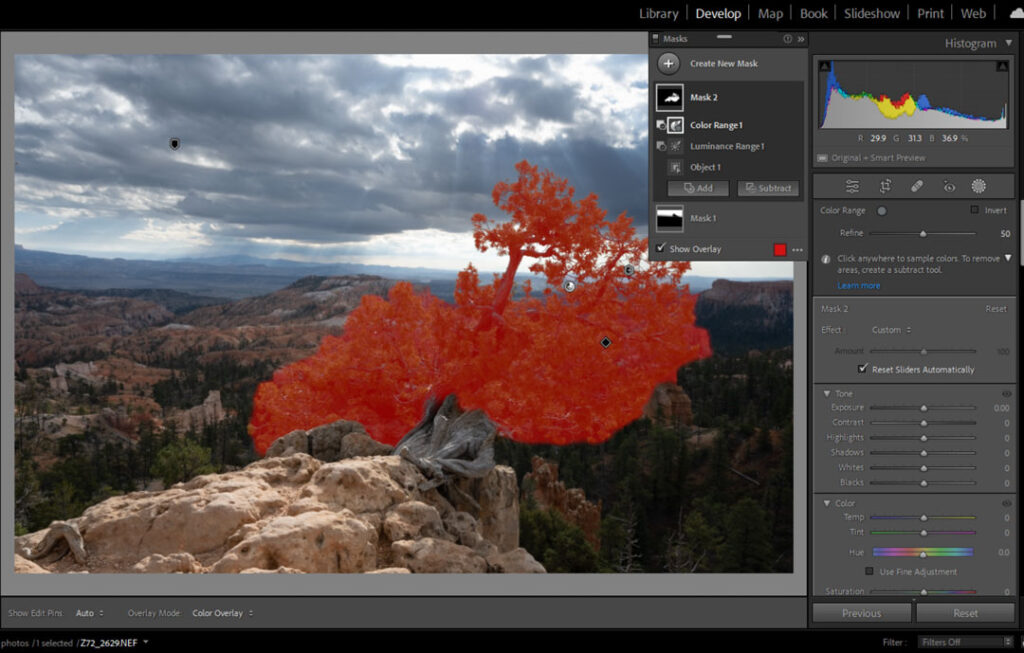
Masking in Lightroom & Adobe Camera Raw

Lightroom and Adobe Camera Raw have features that allow masking of photographic images. Masking is essentially ‘dodging’ and ‘burning’ your digital image, only supercharged. In addition to lightening or darkening areas of your photo, masking allows you to change much more, like saturation and contrast.
One of the best recent features is ‘intersecting masks‘ – the combining of more than one mask to resolve specific elements in a photo, like petals, leaves, or particular color.

Applying A Mask
By applying a mask, the photographer can manipulate specific areas or objects in an image to emphasize and eliminate elements. Both Lightroom and Adobe Camera Raw have masking AI (artificial intelligence) that can automatically select specific areas of the photo, like a person, sky, or background. Additionally, you can add or subtract to the mask by selecting specific mask criteria like color or luminescence, or by using a brush or eyedropper to select a detail.

Continue reading “Masking in Lightroom & Adobe Camera Raw”

Tutorial: Adding Bokeh w/ Photoshop 2022-2023

I love bokeh and when shooting with my micro 4/3 Olympus or Panasonic camera, bokeh isn’t as good. Adobe Photoshop 2023 (& 2022) have include ‘neural filters’ – artificial intelligence filters – that can recognize and auto-select (auto-mask) the main subject. The amount of blur is a slider that can really add a nice bokeh effect to soften a background. The latest version is excellent at simulating depth-of-field – making the plane of the subject sharp. This works with any photo you can import & edit in Photoshop so any camera format – micro 4/3, APS-C, Full-Frame, iPhone.

Continue reading “Tutorial: Adding Bokeh w/ Photoshop 2022-2023”